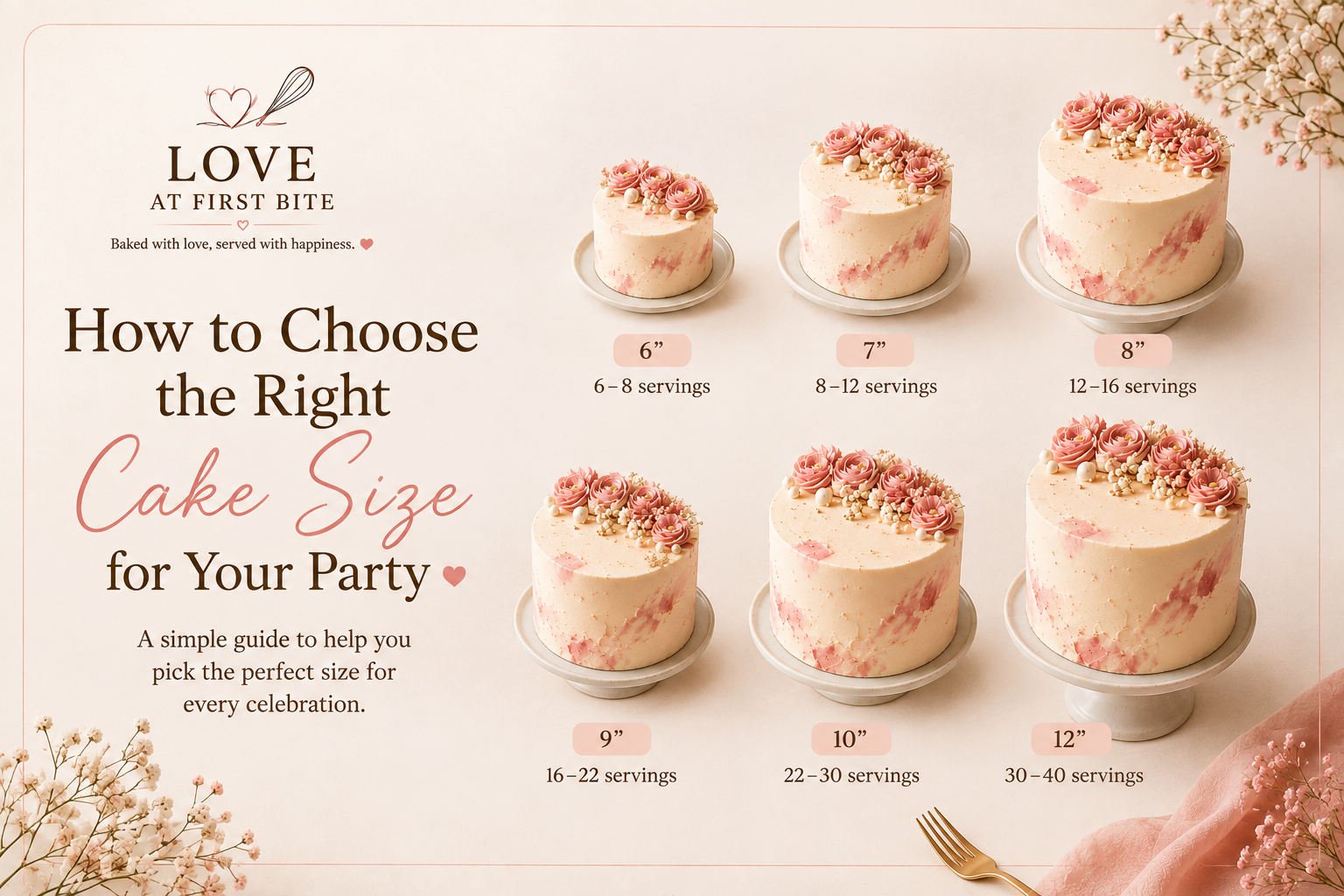
How to Choose the Right Cake Size for Your Party ? Choosing the right cake size for a party may seem simple, but it can quickly become confusing. Should you order a 1 kg cake or 2 kg? Will one cake be enough for everyone? What if some guests want a second slice? And how do you choose the right size when the cake is the centrepiece of a birthday, anniversary, wedding, or other celebration?
The cake is more than just a dessert. It is often one of the most memorable parts of a celebration. You want every guest to get a satisfying slice without ordering so much cake that there is a large amount left over. At the same time, you do not want to run out of cake before everyone has had a chance to enjoy it.
The right cake size depends on several factors, including the number of guests, type of event, serving style, cake shape, number of other desserts, and how generous you want each slice to be.
In this guide, we will explain how to choose the right cake size for your party, provide a practical cake serving guide, discuss common cake sizes, and share useful tips to help you order with confidence.
Why Choosing the Right Cake Size Matters
Ordering the correct cake size can make your celebration more convenient and cost-effective.
If you order a cake that is too small, some guests may not receive a proper serving. You may also have to cut very small pieces, which can make the cake-cutting experience less enjoyable.
On the other hand, ordering a cake that is much larger than necessary can increase your budget and leave you with more leftovers than you expected.
Finding the right balance means considering how many people will actually eat the cake and how much cake each person is likely to have.
For example, a small family celebration with six to eight people does not usually require the same cake size as a birthday party with 25 or 30 guests.
The goal is simple: choose a cake that provides enough servings for your guests while matching the style and scale of your celebration.
1. Start With the Number of Guests
The most important factor when choosing cake size is the number of people attending your party.
Before ordering, make a realistic guest count. Do not simply estimate based on the number of invitations you send. Think about how many people are actually expected to attend and how many are likely to eat cake.
A useful starting point is:
- 5–8 guests: around 500 g to 1 kg
- 8–12 guests: around 1 kg
- 12–18 guests: around 1.5 kg
- 18–25 guests: around 2 kg
- 25–35 guests: around 2.5–3 kg
- 35–50 guests: around 3–4 kg
- 50+ guests: consider multiple cakes or a larger custom cake
These are general estimates rather than fixed rules. The actual number of servings can vary depending on the cake’s shape, height, flavour, decoration, and how the cake is sliced.
If you are unsure between two sizes, it is usually helpful to discuss your guest count and serving expectations with your baker.
2. Understand Cake Weight and Servings
In many Indian bakeries and home bakeries, cakes are commonly ordered by weight, such as 500 g, 1 kg, 1.5 kg, 2 kg, and so on.
However, cake weight does not automatically tell you the exact number of servings.
Two cakes weighing the same amount can serve different numbers of people depending on their shape and height.
For example, a tall cake may provide more slices than a shorter cake of similar weight. Similarly, a rectangular cake can sometimes be cut into portions differently from a round cake.
As a general guide:
| Cake Weight | Approximate Servings |
|---|---|
| 500 g | 4–6 people |
| 1 kg | 8–12 people |
| 1.5 kg | 12–18 people |
| 2 kg | 18–25 people |
| 2.5 kg | 25–30 people |
| 3 kg | 30–36 people |
| 4 kg | 40–50 people |
| 5 kg | 50–60+ people |
These numbers should be treated as approximate because serving size and cake design can change the final number of portions.
If cake is the main dessert at your party, consider choosing a slightly larger size. If there are several other desserts, a smaller cake may be sufficient.
3. Think About the Type of Party
Not every celebration requires the same amount of cake.
A birthday party, office gathering, anniversary dinner, children’s party, and wedding reception may have completely different serving requirements.
Birthday Parties
Birthday parties are often cake-focused celebrations, especially when children are involved.
Guests may expect a slice after the cake-cutting ceremony, and children may enjoy smaller portions.
For a children’s birthday party, you can usually plan smaller slices, especially if there are snacks, chocolates, cupcakes, or other desserts available.
For an adult birthday dinner, guests may prefer a more generous serving.
If you are hosting 15 people, for example, a 1.5 kg to 2 kg cake could be considered depending on the other food being served.
Anniversary Celebrations
Anniversary celebrations are often smaller and more intimate.
If you are celebrating with close family or your partner, a 500 g to 1 kg cake may be enough for a small gathering.
For a larger anniversary party with 20–30 guests, you may want a 2 kg or larger cake depending on the menu.
Office Parties
Office celebrations can be slightly different because people may only take a small piece of cake.
If you are ordering a cake for an office birthday or work celebration, consider how many people will actually participate.
A cake for 20 employees does not necessarily need to be the same size as a cake for 20 guests at a family dinner.
Weddings and Large Events
Large celebrations require more careful planning.
Instead of ordering one extremely large cake, you can consider a tiered cake or multiple cakes. This can make serving easier and provide guests with different flavours.
For a wedding or large reception, the baker or catering team can help estimate servings based on the number of guests.
4. Consider How Many Other Desserts You Are Serving
The amount of cake your guests eat depends heavily on what else is available.
Imagine a birthday party where the only dessert is cake. Guests are more likely to take a larger slice.
Now imagine a celebration with:
- Cake
- Cupcakes
- Brownies
- Cookies
- Ice cream
- Gulab jamun
- Pastries
- Chocolates
- Other desserts
In this situation, guests may take a smaller piece of cake because they want to try other desserts too.
Therefore, you do not always need to order a huge cake simply because there are many guests.
If cake is the main dessert, plan for more generous servings.
If cake is one of several desserts, you may be able to choose a slightly smaller cake.
5. Decide What Type of Cake Slices You Want
Serving size also matters.
A small dessert slice may be enough after a large meal. However, if cake is being served as the main dessert, guests may expect a larger portion.
For children’s parties, smaller slices are usually practical.
For adult celebrations, medium-sized slices may be more appropriate.
For events where guests are likely to take seconds, ordering extra cake can be helpful.
It is better to think in terms of servings rather than just kilograms.
Ask yourself:
How much cake do I want each guest to receive?
Once you answer that question, choosing the cake size becomes much easier.
6. Round Cakes vs. Square Cakes
The shape of your cake can affect how many portions you can get from it.
Round cakes are one of the most popular choices for birthdays and smaller celebrations. They are easy to display and look attractive during cake-cutting ceremonies.
Square and rectangular cakes can be useful for larger gatherings because they can often be cut into uniform portions efficiently.
For example, if you are hosting a large office party, a rectangular cake may be easier to divide into many similar-sized pieces.
Your baker can recommend the most practical shape based on the number of servings you need.
7. Consider the Cake’s Height
Cake weight is not the only factor that determines its size.
The height of the cake can make a significant visual difference.
A tall cake can look impressive even when it has a relatively small diameter. Taller cakes can also be sliced into smaller portions vertically.
If you want a cake that looks large and impressive without dramatically increasing the number of servings, you can discuss a taller design with your baker.
However, the final serving count should still be confirmed based on the cake’s actual dimensions.
8. Choose the Cake Size According to Your Budget
Budget is another important factor.
A larger cake generally requires more ingredients and more preparation, which increases the price.
Before choosing a size, decide how much you are comfortable spending.
If you have a limited budget, you do not necessarily have to choose an elaborate oversized cake.
Instead, you can focus on:
- The right number of servings
- A simple but attractive design
- Your preferred flavour
- Quality ingredients
- Minimal but meaningful decoration
A beautifully designed 1 kg cake can sometimes be more suitable for a small celebration than a large cake that creates unnecessary leftovers.
9. Think About the Cake Design
The design you choose can also influence the cake size.
Some designs require more space.
For example, a customized birthday cake with multiple decorative elements, toppers, characters, flowers, messages, or themed details may look better on a larger cake.
A simple cake with minimal decoration can look beautiful even at a smaller size.
If you have a specific design in mind, show the reference image to your baker and ask what cake size would work best.
The baker can help determine whether the design can be recreated on a 1 kg cake or whether a larger cake would provide better proportions.
10. When Should You Order a 500 g Cake?
A 500 g cake can be suitable for a very small celebration.
It may work well for:
- Two to four people
- Small family celebrations
- Couple celebrations
- Simple anniversary moments
- Small surprise parties
- Personal celebrations
However, if you have more than a few guests, a 500 g cake may not provide enough servings.
If you are planning a small celebration but expect everyone to want a generous piece, consider moving up to 1 kg.
11. When Should You Order a 1 kg Cake?
A 1 kg cake is one of the most practical choices for small and medium-sized celebrations.
It can work well for approximately 8–12 people depending on portion size.
A 1 kg cake is suitable for:
- Small birthday parties
- Family celebrations
- Anniversaries
- Small office celebrations
- Get-togethers
- Small dinner parties
It is also a convenient option when you want enough cake without having a large quantity left over.
12. When Should You Order a 2 kg Cake?
A 2 kg cake is suitable for a larger gathering.
Depending on serving size, it can provide approximately 18–25 servings.
Consider a 2 kg cake when you are hosting:
- A medium-sized birthday party
- A family gathering
- An office celebration
- A larger anniversary celebration
- A small community event
If there are around 20 guests and cake is the primary dessert, a 2 kg cake can be a practical starting point.
13. When Should You Order a 3 kg Cake?
A 3 kg cake may be suitable for approximately 30–36 servings, depending on the cake and serving size.
This size is useful for larger celebrations where many guests will be having cake.
For example, a 3 kg cake can be considered for:
- Large birthday parties
- School celebrations
- Office events
- Family functions
- Community gatherings
For even larger events, multiple cakes may be easier to handle than one very large cake.
14. Should You Order One Large Cake or Multiple Smaller Cakes?
This is an important question for large celebrations.
Suppose you have 50 guests.
You could order one 5 kg cake, or you could choose two or more smaller cakes.
Multiple cakes can provide several advantages.
First, you can offer different flavours.
For example:
- Chocolate
- Vanilla
- Red velvet
- Strawberry
- Butterscotch
This gives guests more choice.
Second, multiple cakes can make serving easier.
Third, different cake designs can be used for different parts of the celebration.
However, one large customized cake may be more suitable if the cake itself is an important visual centrepiece.
The choice depends on your event, budget, design requirements, and serving preferences.
15. Don’t Forget About Children
If children make up a large portion of your guest list, you may be able to plan smaller slices.
Children usually eat less cake than adults, although this varies from child to child.
For a children’s birthday party, you may also have other foods such as:
- Pizza
- Sandwiches
- Snacks
- Fries
- Cupcakes
- Chocolates
- Ice cream
- Cookies
If many of these foods are being served, guests may take smaller cake portions.
However, it is still wise to keep a little extra cake available because children may ask for another slice of their favourite flavour.
16. Consider Adults and Teenagers Separately
Adults and teenagers may prefer larger servings than young children.
If your guest list contains mostly adults, use a more generous serving estimate.
For example, if you are expecting 20 adults and cake is the main dessert, choosing a cake based on the smallest possible serving estimate may leave you short.
A slightly larger cake can provide more flexibility.
17. Plan for Seconds
Some celebrations are casual, and guests may return for another piece.
This is especially common when the cake is popular or when guests have a favourite flavour.
If you know your family and friends enjoy cake, consider ordering a little extra.
You do not need to double the cake size, but having a few extra servings can prevent the cake from running out.
A simple rule is:
If you are uncertain between two cake sizes and leftovers are acceptable, choose the slightly larger option.
18. What If You Want Leftovers?
Some people actually prefer having leftover cake.
Leftovers can be enjoyed the next day or shared with family members.
If you want cake for the day after your party, factor that into your order.
For example, instead of ordering exactly enough for 20 guests, you might choose enough for 22–24 servings.
This is particularly useful for homemade cakes that you enjoy having with tea or coffee the next day.
However, make sure the cake is stored properly according to its ingredients and the baker’s storage instructions.
19. Don’t Choose Cake Size Based Only on Appearance
One common mistake is choosing a cake simply because it looks large in a photograph.
Cake photographs can be misleading.
A cake may appear large because of:
- Tall layers
- Wide cake boards
- Decorative elements
- Toppers
- Perspective
- Photography angles
- Additional props
Always ask the baker about the actual weight and approximate servings.
If you are ordering online, check whether the listed weight refers to the finished cake or another measurement.
20. Ask Your Baker for a Serving Recommendation
If you are still unsure, ask your baker.
Provide them with three important details:
- Number of guests
- Type of event
- Whether cake is the main dessert
For example, instead of simply saying:
“I need a cake.”
You can say:
“I am hosting a birthday party for around 25 people. Cake will be the main dessert, and I would like medium-sized servings. What cake size would you recommend?”
This gives the baker enough information to make a more useful recommendation.
Quick Cake Size Guide
Here is a simple reference you can save:
500 g Cake
Approximate servings: 4–6
Best for: Couples, very small celebrations, small family gatherings
1 kg Cake
Approximate servings: 8–12
Best for: Small birthdays, anniversaries, family celebrations
1.5 kg Cake
Approximate servings: 12–18
Best for: Medium family gatherings and small parties
2 kg Cake
Approximate servings: 18–25
Best for: Medium-sized parties and office celebrations
2.5–3 kg Cake
Approximate servings: 25–36
Best for: Larger birthdays, family functions, and gatherings
4–5 kg Cake
Approximate servings: 40–60+
Best for: Large events and celebrations
Remember that these are approximate numbers. The final serving count depends on the cake’s dimensions, shape, height, and serving size.
Common Mistakes to Avoid When Choosing Cake Size
Mistake 1: Ordering Based Only on Weight
Weight is useful, but it does not tell the complete story.
Always consider the expected number of servings.
Mistake 2: Forgetting Other Desserts
If your party has several desserts, guests may eat smaller pieces of cake.
Mistake 3: Ignoring Children
Children generally require smaller portions, although individual appetites vary.
Mistake 4: Choosing a Cake That Is Too Small for the Design
Some customized designs need additional space.
Discuss the design with your baker before finalizing the size.
Mistake 5: Not Planning for Extra Guests
If you expect that additional guests may arrive, consider ordering a few extra servings.
Mistake 6: Assuming All 1 kg Cakes Serve the Same Number of People
Different cake shapes and designs can affect serving sizes.
A Simple Formula for Choosing Your Cake Size
You can make the decision easier by following these steps:
Step 1: Count Your Guests
Write down the number of people expected at the celebration.
Step 2: Estimate Cake Eaters
Not everyone may want cake, but it is safer to plan for most guests if cake is the main dessert.
Step 3: Consider Portion Size
Decide whether you want small, medium, or generous slices.
Step 4: Check the Other Desserts
If there are many other sweets, slightly smaller cake servings may be enough.
Step 5: Consider Your Design
Ask whether your desired cake design needs a particular size or shape.
Step 6: Add a Small Buffer
If you are unsure, include a few extra servings.
Step 7: Confirm With Your Baker
Share your guest count, event type, flavour, and design with your baker before placing the final order.
Example: Choosing a Cake for a Birthday Party
Let’s say you are planning a birthday party for 20 people.
You are serving:
- Snacks
- Pizza
- Beverages
- Cake
- Ice cream
Because there are several food items and another dessert, guests may take medium or small slices of cake.
A 2 kg cake could be considered, depending on the desired serving size and the cake’s dimensions.
Now imagine a different party with 20 adults where cake is the main dessert.
In that situation, you may want to plan more generously.
The important lesson is that guest count alone does not determine cake size.
You need to consider the complete celebration.
Example: Choosing a Cake for an Anniversary
Imagine a couple is celebrating their anniversary with 10 family members.
There are 12 people in total, and cake is being served after dinner along with tea and coffee.
A 1 kg cake may be a practical choice depending on the desired portion size.
If the couple wants to save some cake for the next day, they may choose a slightly larger cake.
For an intimate celebration of just four people, a 500 g cake may be enough.
Example: Choosing a Cake for an Office Party-How to Choose the Right Cake Size for Your Party?
Suppose 30 employees are celebrating a colleague’s birthday.
People will take small pieces because the celebration is happening during a workday and snacks are also being served.
Instead of automatically choosing a very large cake, discuss the expected serving size with your baker.
A 2.5–3 kg cake may be considered depending on the portions and cake dimensions.
For a larger office event, multiple cakes can also make distribution easier.
How to Make Sure Everyone Gets a Piece-How to Choose the Right Cake Size for Your Party?
The way you cut the cake matters.
A cake can be divided into smaller, uniform portions to serve more people.
If you are serving a large group, ask someone experienced in cake cutting to handle the portions.
For large events, rectangular cakes can sometimes be easier to portion than highly decorated round cakes.
For weddings and other formal functions, professional catering teams often have established serving methods.
Cake Size Is Not the Same as Cake Quality
When choosing a cake, size should not be the only consideration.
You should also think about:
- Freshness
- Ingredients
- Flavour
- Texture
- Hygiene
- Customization
- Presentation
- Baker’s experience
- Storage and delivery
A slightly smaller cake made with quality ingredients may be more satisfying than a very large cake chosen only because of its weight.
The ideal cake balances quantity, quality, flavour, design, and budget.
Final Cake Size Checklist-How to Choose the Right Cake Size for Your Party?
Before placing your cake order, ask yourself:
☐ How many guests are attending?
☐ How many people are likely to eat cake?
☐ Are most guests adults or children?
☐ Is cake the main dessert?
☐ What other desserts will be served?
☐ Do I want small, medium, or generous slices?
☐ Do I want leftovers?
☐ What cake design am I choosing?
☐ Does the design require a particular cake size?
☐ What is my budget?
☐ Have I confirmed the serving estimate with my baker?
If you can answer these questions, choosing your cake size becomes much easier.
Final Thoughts-How to Choose the Right Cake Size for Your Party?
Choosing the right cake size for your party does not have to be complicated. The best starting point is always the number of guests, but several other factors should be considered before placing your order.
Think about the type of celebration, the age of your guests, the number of other desserts, the serving size you want, your cake design, your budget, and whether you want leftovers.
For a small gathering, a 500 g or 1 kg cake may be enough. For medium-sized celebrations, 1.5 kg to 2 kg can be a practical range. Larger parties may require 2.5 kg, 3 kg, 4 kg, or even multiple cakes.
Most importantly, remember that cake serving estimates are not exact. Cake shape, height, decoration, recipe, and cutting style can all affect the final number of portions.
When in doubt, communicate your requirements clearly to your baker. A good baker can help you choose a size that fits your guest count, celebration, design, and budget.
After all, the perfect cake is not necessarily the biggest cake. It is the cake that gives your guests enough to enjoy while fitting naturally into your celebration.
So, before your next birthday, anniversary, family gathering, or special occasion, count your guests, think about your menu, choose your preferred serving size, and then select your cake accordingly.
With a little planning, you can make sure there is enough cake for everyone—and make the cake-cutting moment one of the sweetest memories of your celebration.
At Love at First Bite, every cake is prepared with care to make your special moments even sweeter.
1 thought on “5 How to Choose the Right Cake Size for Your Party ? best”